Free website created on



Le Soleil - Architecture Section
Espace St. Andrew's: community before building
By Félix Lajoie | July 7, 2023
(Voir l'article original en Français au bas de la page)
To ensure the longevity of its place of worship and its community, St. Andrew's Presbyterian Church adopted an original solution: to transform its building in Old Quebec into a multifunctional hall available for public and private events.
It was a "really difficult decision to make", and the preliminary thinking went on "for almost 10 years", says Guy Morisset, a member of St. Andrew's Presbyterian Church who holds several titles, including Property Committee.
"We had three heritage buildings to maintain, and our community wasn't very large anymore. We realized that it didn't make sense anymore, that there was no longer a balance between our needs and maintenance costs," begins Mr. Morisset.
The Presbyterian community realized the importance of "thinking outside the box" if they wanted to keep their church and their congregation. That's where Cynthia Hovington and her project and event management company, Kamaï, came in.
"From the very first meeting, we felt we'd found the right partners, people who understood our situation," recalls Morisset.
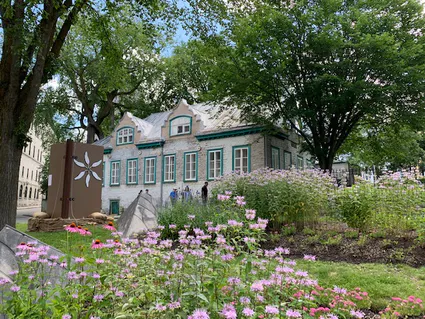
The Presbyterian congregation and Kamaï thus became partners in 2019, the latter having signed a contract to manage and operate the church located on Cook Street, a stone's throw from Quebec City's City Hall.
The new partners have also invested an estimated $1 million in major renovations.
According to Mr. Morisset, the work already accomplished by Kamai at Espace Saint-Grégoire, a Beauport church that was transformed into a reception hall in 2015, strongly convinced them.
Reversing the dynamic
Cynthia Hovington agrees: quickly, in talking with church members, she realized just how much they were "in solution mode".
"There was a lot of openness in the community to rethink themselves and make sure that everyone could enjoy the place, while keeping their building," confirms Ms. Hovington.
The renovations took some time to complete, following delays caused by the pandemic, but the majority were finally completed a few weeks ago.
The pews, light fixtures, carpet, mosaics and wall colors have all disappeared, giving way to the white and brightness characteristic of contemporary decor.
"We really pared down the decor to make it a versatile place without permanent elements. It also highlights the stained-glass windows and other heritage elements we've kept," explains Ms. Hovington.
The main hall and mezzanine of the newly renovated Espace St. Andrew's can now accommodate up to 300 people. Receptions, banquets, conferences, weddings, shows, exhibitions: it's all possible, according to Ms. Hovington.
"There will also be a catering kitchen, which can be transformed into a dressing room for artists. It's still being renovated," notes the founder of Kamai.
For the congregation, the new vocation of the church, built in 1810, is a real turnaround.
"We realized how valuable this building was, and we simply had to find a way to reverse the situation. Now, instead of the community sustaining the church, we're sustaining it," says Mr. Morisset.
Worship continues
So, every Sunday morning, the faithful still gather in the same place, but in a somewhat different setting. They also sit on banquet chairs, instead of the classic wooden pews."We've kept the organ and pulpit. It now has wheels, so we can move it anywhere," stresses Ms. Hovington.
According to Morisset, church members all had "a bit of a shock" the first time they walked in after the renovations. However, most of the changes were "quickly forgotten".
"We still have our church, which is now very brightly lit, and we still have our organ. We haven't lost anything: we haven't lost the history or the memories, because we're still here to keep them alive," he says.
The efforts and sacrifices that church members must make in order to cohabit with other events bring certain advantages, Mr. Morisset maintains.
"After each ceremony, we have to put the place back the way it was before. Chairs and furniture have to be replaced. It gives us a much greater sense of belonging than staying on our own in our little community."
"Before, we didn't have air conditioning... We didn't have a basement either!" concludes Mr. Morisset proudly.
CTV News
Facing loss of historic church, Quebec City anglophones plan to save it -- by opening the doors by Kelly Craig and Selena Ross
MONTREAL, September 9, 2020 -- It’s a tough time for churches—not just COVID-19, but the modern era, with church attendance declining for decades and buildings aging.
Now consider trying to shore up support while also being a Presbyterian church founded by Scots in the heart of old Quebec City.
But a historic English-speaking congregation in the provincial capital has found a way—it hopes—to keep their church not only alive but flourishing, indefinitely.
St. Andrew’s Church used to be an important meeting place in the heart of the old city.
“There was room for maybe 300 people,” said Guy Morisset, who is on the St. Andrew’s board of directors.
Scottish soldiers who fought on the Plains of Abraham founded the congregation in 1759, and then the church, beginning construction in 1810.
After deciding to stay in Quebec, the “highlanders” petitioned King George III to grant them the land to build upon. It became the first Presbyterian church of Scottish origin in all of Canada.
St. Andrew’s still has spectacular stained-glass windows, some of them dating back to the 1800s.
“The soldiers would be in the balconies and the families would be down on the ground floor,” said Morisset.
Its bells have rung out over Quebec City ever since—until last year. Like so many other churches, it had trouble paying its repair bills and the board had considered moving to a different building.
Then it came up with a Hail Mary idea. Over the last nine months, the building was completely renovated inside, stripped down to the stones.
When the work is finished by around December, it’ll be transformed, not just in look and in purpose.
St. Andrew’s will be a church on Sundays, but during the rest of the week it will open its doors to the rest of the community for various events such as meetings or receptions.
“Everything will be white with a big candelabra,” said Cynthia Hovington of the company Kamai Project Management, which partnered with the church to do the renos, which cost nearly $1 million, and to manage the booking system.
Aside from helping pay the bills, this is a fitting use for the 210-year-old building, says its minister.
“The building will be used by the community,” said Rev. Dr. Katherine Burgess.
“I think that's more important, in some ways, because it brings the community into the Church.”
In a city full of small heritage buildings—at least within the walls of old Quebec City—the church will be one of the only spaces aside from the Chateau Frontenac that can fit 250 people.
But they also hope that it’s a model that can protect the building, its congregation and its history with no further crises.
“St Andrew's now, we hope, will never close,” said Burgess.
Back to Welcome Page / Retour à l'accueil
(Français en bas) The church, at 5 Cook street, is still being used as a presbyterian sanctuary on Sundays, 11 am. It has also become a multi purpose hall for other events that are managed by Kamaï Événements.
The Kirk Hall and the Manse are rented as offices and apartments. The church has an office in the Kirk Hall, and the Sunday school classroom is in the Manse.
St. Andrew's also owns the presbyterian cemetery in Inverness, Quebec, in Beauce.
St. Andrew's Burial Lot at Mount Hermon Cemetery
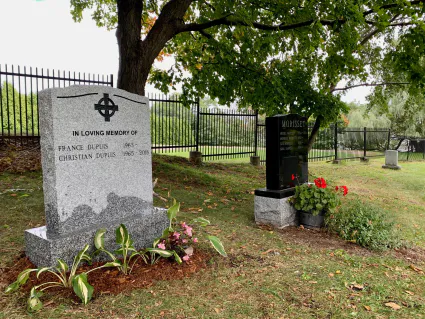
Here in town, at Mount Hermon Cemetery in Sillery, Quebec City, a family burial plot was acquired by a member St. Andrew's and spaces are made available for church members. The headstone is adorned with a simple Celtic cross, providing a sense of universal belonging and love. The lot is in a lovely location under a tree, next to another Presbyterian family lot, with a partial view on the St. Lawrence river. The lot can have only one headstone, but multiple names can be engraved on the stone. As of 2026, there is room for four more names with dates, and four urns. This may be an interesting option for people who are alone.
Mount Hermon Cemetery is a garden cemetery and National Historic Site of Canada.
/
L’église St. Andrew's, au 5 rue Cook, continue d’être utilisée comme lieu de culte presbytérien (en anglais) les dimanches à 11 h. Elle sert également de salle polyvalente pour divers événements organisés par Kamaï Événements.
La salle paroissiale (Kirk Hall) et le presbytère (Manse) sont loués comme bureaux et appartements. L'église a toujours un bureau dans le Kirk Hall et la salle de classe de l'école du dimanche est dans la Manse.
L’église St. Andrew's possède également le cimetière presbytérien à Inverness, Québec, dans la Beauce.
Le lot de St. Andrew's au cimetière du Mont-Hermon
Ici en ville, au cimetière Mount Hermon, à Sillery, Québec, un lot familial a été acquis par un membre de St. Andrew's et des emplacements y sont mis à la disposition des membres de l'église. La pierre tombale est ornée d'une simple croix celtique, symbolisant un sentiment d'appartenance et d'amour universels. Le lot est situé dans un cadre charmant, sous un arbre, à côté d'un autre lot familial presbytérien, avec une vue partielle sur le fleuve Saint-Laurent. Le lot ne peut accueillir qu’une seule pierre tombale, mais plusieurs noms peuvent y être gravés. À compter de 2026, il reste de la place pour quatre noms supplémentaires accompagnés de dates, ainsi que pour quatre urnes. Cela pourrait constituer une option intéressante pour les personnes seules.
Le cimetière du Mont-Hermon est un cimetière-jardin et un lieu historique national du Canada.
In spite of all the changes that have happened inside the church building, the stained glass windows are still intact.
St. Andrew's Stained Glass Windows
The windows of the church provide a fine example of 19th century stained glass. Only two of the windows, located in the ceiling, are of the 20th century. The four corner windows of the church which are shown first are the original ones. Deceptive in their seeming simplicity, we observe the complexity of Celtic scroll work along with the St. Andrew's cross in the middle of some of the circles. The circle motif in Celtic scroll work is taken by most observers to be a symbol of eternity, that is without beginning or end, and hence the symbol of God.
/
En dépit de tous les changements qui ont eu lieu à l'intérieur de l'église, les vitraux sont toujours intacts.
Les vitraux de l'église St. Andrew's
Les fenêtres de l'église sont un bel exemple de vitrail du 19ème siècle. Seulement deux des fenêtres, situées dans le plafond, sont du 20ème siècle. Les fenêtres aux quatre coins de l'église (premières photos) sont celles d'origine. Malgré leur apparente simplicité, nous pouvons remarquer une certaine complexité dans le détail des volutes celtiques ainsi que la présence de la croix de Saint-André au milieu de certains des cercles. Ce motif récurrent de cercles est interprété par la plupart des observateurs comme un symbole de l'éternité, qui est sans commencement ni fin, et est donc le symbole de Dieu.




Copyright 2020 - 2026 Église St. Andrew's Presbyterian Church, 5 rue Cook, Québec, QC, Canada.