Free website created on



The Empty Cross of the Resurrection
The empty cross is a visual reminder of Jesus' resurrection, emphasizing that death was not the end but rather a gateway to eternal life. Many Protestant denominations favour the empty cross, often viewing it as a more appropriate symbol for the triumph of the resurrection.
The Presbyterian cross, often referred to as a Celtic cross, is a symbol with roots in Celtic Christianity and the Scottish Reformation. It typically features a cross enclosed within a circle, often adorned with Celtic knotwork. The circle around the cross may be interpreted as representing eternity, the sun, or the cycle of life and death
The Burning Bush
The burning bush is a significant event in the Bible, It describes Moses encountering a bush that was on fire but not consumed by the flames. In Exodus 3:14, the phrase "I AM that I AM" is God's response to Moses' question about his name when Moses encounters God in the burning bush. This declaration reveals God's self-existent, eternal, and absolute nature. It signifies that God is the source of all being.
The Tartan of St. Andrew's Quebec City was designed by David Stafford and the congregation in 2002. The golden yellow is for "our past, present and future members". Blue for the Presbyterian Church and St. Andrew's Cross. Green "our verdant surrounding hills'" Orange is the "predominant colour in the Fraser tartan of our founders". Red is for Canada. White for the snow that "characterises our Nordic winters". /
Historical Highlights
This congregation had its beginning with the beloved Chaplain, Rev. Robert MacPherson and soldiers of the famous Fraser Highlanders of Wolfe's Army in 1759.
With the Peace Treaty of 1763, and the coming of merchants from Scotland and New England, the congregation soon assumed civilian status and was known as the Scotch Congregation - in connection with the Church of Scotland.
In 1802, in response to a petition signed by 148 persons, the present Church site was granted by His Majesty George III, although it was not until 1809 that construction began.
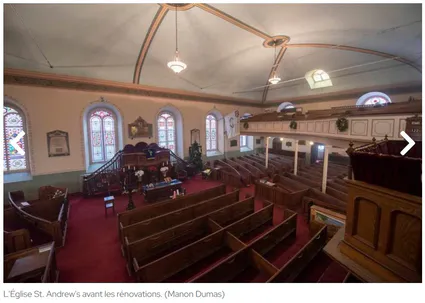
The long-contemplated Church was dedicated on November 30th, 1810, on St. Andrew's day, and appropriately named after the apostle. Besides the addition of the Vestry in 1900, the building remained virtually unchanged until the 2020 renovations.
On the same triangular site with the church are the Kirk Hall, first erected in 1829 as a Protestant School which continued as a flourishing scholastic institution for many years; and the magnificent Manse, erected in 1837, which has been the residence of the ministers until May 2017. /
Faits saillants
Cette congrégation a fait ses débuts avec le bien-aimé aumônier, le révérend Robert MacPherson et soldats des célèbres Fraser Highlanders de l'armée de Wolfe en 1759.
Avec le Traité de paix de 1763, et la venue des marchands de l'Écosse et de la Nouvelle-Angleterre, la congrégation prit bientôt un statut civil et était connue comme la Congrégation Scotch - dans le cadre de l'Église d'Écosse.
En 1802, en réponse à une pétition signée par 148 personnes, le site actuel de l'Église a été accordé par Sa Majesté George III, bien que ce ne fut qu'en 1809 qu'ait commencé la construction.
L'Église fut enfin consacrée le 30 Novembre 1810, le jour de la Saint-André. À part l'ajout de la sacristie en 1900, le bâtiment est resté pratiquement inchangé jusqu'en 2020 ou des rénovations majeures ont lieu.
Sur le même site triangulaire que l'église se trouve le Kirk Hall, érigé en 1829 comme école protestante, puis comme institution scolaire florissante pendant de nombreuses années; et la magnifique Manse, érigée en 1837, qui a été la résidence des pasteurs jusqu'en mai 2017.


Copyright 2026 Église Presbytérienne St. Andrew's Presbyterian Church, Québec, QC, Canada.